Now Booking 2027 & 2028 Weddings
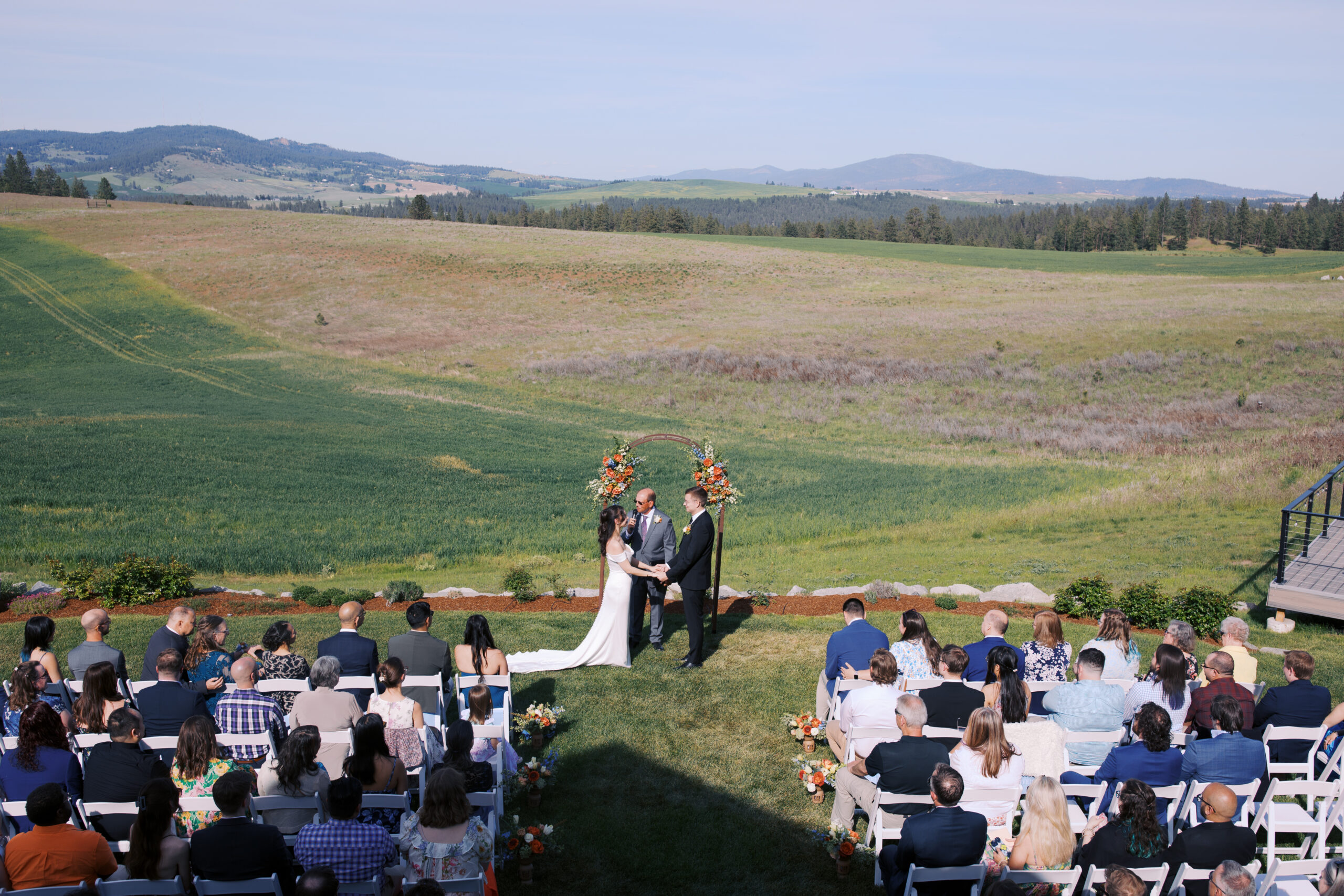

Throughout my 10 years as a Wedding Photographer I’ve learned a thing or two that I wish I would have known when I was planning my wedding. If you’d like to learn tips & tricks, see real weddings, and sessions then this blog is for you! I hope this can be a tool for all my couples and anyone searching for wedding inspiration.
HEY FRIEND! I'm Kristina

Your wedding day goes by faster than you think — and the more space we carve out to be with your people, the better it feels. This post is the long answer on how to actually build a wedding day timeline that earns its hours: where the time goes, what’s worth fighting for, and how to keep the day from turning into a race.
Three real timelines below — the two 8-hour structures we use most (one with a first look, one without) plus the 10-hour version for couples who need more room. Before that, a few things worth knowing.
Why most wedding timelines feel rushed
A few common reasons:
Underestimating how long things actually take. Hair and makeup runs long. A wedding party of eight needs more time for portraits than a wedding party of two. A 12-minute drive between locations is 25 minutes when 60 people are loading into cars.
Stacking the day with too many “moments.” Once you start adding everything — first look, separate looks for parents, sparkler exit, cake cutting, bouquet toss, sunset photos, choreographed first dance — you’re choreographing a small theatrical production. Some of those make the day. Not all of them.
Forgetting transitions. Most timelines budget time for events but no time for getting from one event to the next. Cocktail hour ends at 5:30 and dinner starts at 5:30, but somehow 60 guests have to relocate to their seats. That doesn’t happen instantly.
No buffer. When something runs long — and something always runs long — there’s nowhere for it to go. The day starts cascading.
Three tips that quietly make everything easier
Get individual wedding party photos done early — especially if you’re not doing a first look. When we photograph each partner with their side of the wedding party earlier in the day, cocktail hour only needs the full-group portraits. That keeps things moving and gets you back to your people sooner.
Keep family groupings to 15 or fewer. The more combinations we shoot, the longer this section takes. Capping around 15 groupings (or fewer) lets us move efficiently and without stress — and you still get the photos that matter most.
Build in buffer time. Ten or fifteen extra minutes between moments gives the day room to breathe even when something runs late. The couples whose weddings feel calm aren’t the ones who planned the most — they’re the ones who planned with margin.
What you actually need to plan time for
A realistic wedding day, broken into the segments that need real time blocks:
Getting ready coverage — 60 to 90 minutes. The first 30 minutes are usually quiet detail shots (rings, dress, invitation suite, flowers). The next chunk is finishing-touches and into-the-dress or putting-on-the-suit. With two photographers, both partners’ getting-ready can happen at once.
First look or no first look — this is the fork in the road that shapes the whole day. We’ll get into the trade-off below.
Couple’s portraits — 30 to 45 minutes minimum, plus ideally a 10–15 minute golden-hour pull during the reception.
Family formals — 15 to 30 minutes for 15 or fewer groupings.
Wedding party portraits — 15 to 30 minutes, depending on size.
Ceremony — 20 to 30 minutes for a non-religious or short religious ceremony. Catholic, Hindu, Jewish, and other full-religious-tradition ceremonies often run 60+ minutes. Build accordingly.
Cocktail hour — 60 minutes.
Reception activities — entrance, first dance, dinner, parent dances, speeches, cake, dancing. Each is its own block.
The 8-hour timeline — with a first look (two photographers)
This is what most of our couples use. Single-location wedding, first look mid-day, moderate-size wedding party.
- 12:00 PM — Photographers arrive, getting ready begins
- 1:15 PM — First look + couple’s portraits
- 2:00 PM — Wedding party portraits
- 2:30 PM — Family portraits
- 3:30 PM — Break + touch-ups
- 4:00 PM — Ceremony
- 4:30–5:30 PM — Cocktail hour (couple joins fully)
- 5:30 PM — Grand entrance
- 5:45–6:15 PM — Dinner
- 6:15 PM — Toasts + cake
- 6:45 PM — First dance + open dancing
- 8:00 PM — Coverage ends
The big payoff here is the cocktail hour. With portraits already done, you actually get to be at your wedding while it’s happening.
The 8-hour timeline — no first look (two photographers)
Some couples want the aisle moment to be the first time they see each other. This timeline keeps that intact while still fitting everything inside 8 hours — but it requires moving the ceremony earlier.
- 12:00 PM — Photographers arrive, getting ready begins
- 1:45 PM — Individual portraits of each partner + venue and detail coverage
- 3:00 PM — Ceremony
- 3:30–4:30 PM — Family, wedding party, and couple’s portraits (couple does not attend cocktail hour)
- 4:30 PM — Grand entrance
- 4:45–5:15 PM — Dinner
- 5:15 PM — Toasts + cake
- 5:45–6:15 PM — Sunset couple portraits
- 6:15 PM — First dance + open dancing
- 8:00 PM — Coverage ends
Trade-off: you’ll miss most of cocktail hour (you’ll be in portraits). You get the aisle moment. Most couples who choose this timeline say the trade is worth it.
The 10-hour timeline — with a first look (two photographers)
You probably need 10 hours if any of the following apply:
- Multiple ceremony or reception locations
- Long religious or cultural ceremony (60+ minutes)
- Large wedding party (10+ on each side)
- A pre-ceremony event you want documented (lunch, tea ceremony, baraat, etc.)
- A late-night exit you want photographed (sparkler send-off, fireworks)
The extra two hours give the day room to breathe and let you say yes to things an 8-hour forces you to cut.
- 11:00 AM — Photographers arrive, detail and venue coverage, getting ready begins
- 1:15 PM — First look + couple’s portraits
- 2:15 PM — Wedding party portraits
- 2:45 PM — Family portraits
- 3:45 PM — Break + touch-ups
- 4:30 PM — Ceremony (allows for longer or religious ceremony)
- 5:30–6:30 PM — Cocktail hour (couple joins fully)
- 6:30 PM — Grand entrance
- 6:45–7:15 PM — Dinner
- 7:15 PM — Toasts + cake
- 7:45 PM — First dance + open dancing
- 8:30 PM — Sunset golden-hour pull
- 8:45 PM — Open dancing continues
- 9:00 PM — Sparkler exit + coverage ends
The extra hour on the front end gets you full detail and getting-ready coverage at a relaxed pace. The extra hour on the back end is what catches sparkler exits, late-night portraits, and dance-floor moments an 8-hour timeline simply can’t fit.
When you’re tempted to skip the first look
Some couples don’t want a first look because the aisle moment matters more than anything. That’s a real preference and worth respecting. Just know what the trade-off is: without a first look, your couple’s portraits, wedding party portraits, and family formals all have to happen after the ceremony — which is why the no-first-look timeline above moves the ceremony earlier and skips cocktail hour.
If “the aisle moment” matters more than the cocktail-hour trade-off, do the traditional reveal. If you want both — the moment AND a relaxed cocktail hour with your people — the first look is the fix.
Common timeline mistakes worth avoiding
- Booking hair/makeup to finish exactly when the photographer arrives. Stack a 30-minute buffer.
- Building a timeline around perfect weather. Have a Plan B for rain or wind that doesn’t fall apart.
- Skipping the golden-hour portrait window. Even 10 minutes during the reception is worth carving out.
- Forgetting to eat. I have seen too many couples not actually sit down for dinner. Sit down. Eat.
- Trying to finalize your timeline without your photographer.
Want a custom timeline for your wedding?
We build one with every couple we book. It’s part of the planning process, not an extra. We always start from your priorities, then work backwards through the day — pulling from our documentary approach so the timeline leaves room for the parts you’ll actually want to remember.
If you’re starting to map out your day, get in touch and let’s talk through it →.
— Kristina
Throughout my 10 years as a Wedding Photographer I’ve learned a thing or two that I wish I would have known when I was planning my wedding. If you’d like to learn tips & tricks, see real weddings, and sessions then this blog is for you! I hope this can be a tool for all my couples and anyone searching for wedding inspiration.
HEY FRIEND! I'm Kristina
© arch and elm photography 2024 | all rights reserved | terms | privacy | site by palme design co.
Get All the Latest Updates When You Sign Up for Our Emails
Don't Miss a thing
08.
07.
06.
05.
04.
03.
02.
01.
